Monthly Archives: 3 月 2026

本校新款學位服借用新制規範及收費標準

為維持學位服品質並延長使用年限,本校業已調整現行借用制度及收費標準。新制規範及收費說明如下:

一、新制規範調整重點

  1. 畢業典禮期間借用彈性化:借用期程調整為2至11週,分為團體借用、三階段「個別借用」及「延長借用」。
  2. 非畢業典禮期間借用:借用期間由原2週調整為1週或2週。
  3. 歸還方式調整:學士服、碩士服及博士服均採「個別歸還」。
  4. 教師借用博士服:於畢業典禮當週,開放參加典禮之專任教師申請借用。

二、收費規定:分級收費制度,依借用期間長短,採不同收費標準。

三、115年度畢業典禮期間作業時程與收費:詳附件。

詳細借用流程將另行公告,如有疑問,請洽各校區承辦人。

陽明校區:事務一組 江小姐,分機:62053  e-mail: freya0055@nycu.edu.tw

交大校區:事務二組 童小姐,分機:51711  e-mail: ginatung@nycu.edu.tw

To maintain the quality of academic regalia and extend its service life, the University has revised the current borrowing regulations and fee standards. The key points of the new regulations and fee standards are as follows:

Ⅰ.Key Adjustments to the New Regulations

  1. Flexible borrowing arrangements during the announced period:The borrowing period has been adjusted to 2–11 weeks. Borrowing options include “group borrowing,” three stages of “individual borrowing,” and “extended borrowing.”
  2. Borrowing outside the announced period:The borrowing duration has been adjusted from 2 weeks to either 1 or 2 weeks.
  3. Return procedure:Bachelor’s, Master’s, and Doctoral regalia shall all be returned individually.
  4. Full-time faculty members borrowing doctoral regalia:Doctoral regalia will be available for borrowing by full-time faculty members during the week of the commencement ceremony.

Ⅱ.Fee Policy: A tiered fee system is adopted. Different fee standards apply based on the length of the borrowing period.

Ⅲ.Schedule and Fees for the 2026 Announced Period: Please see the attached file.

Further details regarding the borrowing procedures will be announced separately. For any inquiries, please contact the designated staff at each campus:

SQSTM1/p62-mediated PD-L1 biomolecular condensate formation promotes lung tumorigenesis

趙瑞益教授研究團隊發表研究成果於J Adv Res.

連結網址:https://pubmed.ncbi.nlm.nih.gov/41730411/

Abstract

Introduction: Biomolecular condensates are membraneless organelles functionally involved in diverse processes, including cancer progression. Sequestosome-1 (SQSTM1)/p62 regulates liquid-liquid phase separation to drive biomolecular condensates, while programmed death-ligand 1 (PD-L1) promotes cancer cell growth. Although SQSTM1 has been shown to form condensates with several complexes, its full range of partners remains incompletely characterized.

Objectives: This study aimed to investigate the role of SQSTM1 in mediating PD-L1 condensate formation and its contribution to lung tumorigenesis.

Methods: The SQSTM1-PD-L1 interaction and condensate colocalization were examined by immunoprecipitation and immunofluorescence. Truncated SQSTM1 constructs validate the interacting domain with PD-L1, which is supported by computational AlphaFold3 analysis. We applied 1,6-hexanediol, FDA-approved PD-L1 antibody Atezolizumab, and CRISPR/Cas9-based SQSTM1 knockout to disrupt SQSTM1/PD-L1 biomolecular condensates, along with in vitro and in vivo experiments. The Survivin levels were analyzed using real-time quantitative PCR and immunoblotting. Clinical correlations of SQSTM1 and PD-L1 expression with prognosis were assessed using public datasets.

Results: Our research demonstrate that SQSTM1, by its Phox1 and Bem1 (PB1) domain, directly interacts with PD-L1 to facilitate the SQSTM1/PD-L1 biomolecular condensate formation. The formation of SQSTM1/PD-L1 condensates prevents PD-L1 from ubiquitin-proteasome-mediated degradation and stabilizes PD-L1 levels. Deletion of the PB1 domain in SQSTM1 inhibits the formation of PD-L1 biomolecular condensates and induces PD-L1 K48 ubiquitination for protein degradation. Disruption of SQSTM1/PD-L1 condensates with 1,6-hexanediol induces PD-L1 proteolysis and reduces cell viability. Knockout of SQSTM1 disrupts PD-L1 condensate formation, downregulates PD-L1 protein levels, and attenuates tumor growth. Treatment with PD-L1 antibody drug Atezolizumab inhibits SQSTM1/PD-L1 condensates and suppresses tumor formation. Clinically, high SQSTM1 and PD-L1 expression correlated with poor prognosis in lung cancer patients.

Conclusion: Together, the SQSTM1 directly interacts with non-membrane-associated PD-L1 to drive the formation of SQSTM1/PD-L1 biomolecular condensates, which prevent PD-L1 degradation, promote lung tumorigenesis, and serve as a potential therapeutic target in lung cancers.

Keywords: Biomolecular condensate; PB1 domain; PD-L1; SQSTM1; Tumorigenesis.

Asynchronous Transitions from High-Risk Hepatoblastoma to Carcinoma.

陳亭妏副教授研究團隊發表研究成果於J Hepatol.

連結網址:https://pubmed.ncbi.nlm.nih.gov/39763896/

Abstract

Most malignant hepatocellular tumors in children are classified as either hepatoblastoma (HB) or hepatocellular carcinoma (HCC), but some tumors demonstrate features of both HB and HCC1-3. These tumors have been recognized under a provisional diagnostic category by the World Health Organization and are distinguished from HB and HCC by a combination of histological, immunohistochemical, and molecular features4-6. Their outcomes and cellular composition remain an open question7-9. The heterogeneous histological and molecular profiles of hepatoblastomas with carcinoma features (HBCs)4 may result from cells with combined HB and HCC characteristics (HBC cells) or from mixtures of cells displaying either HB or HCC signatures. We used multiomics profiling to show that HBCs are mixtures of HB, HBC, and HCC cell types. HBC cells are more chemoresistant than HB cells, and their chemoresistance-a driver of poor outcomes10-12-is determined by their cell types, genetic alterations, and embryonic differentiation stages. We showed that the prognosis of HBCs is significantly worse than that of HBs. We also showed that HBC cells are derived from HB cells at early hepatoblast differentiation stages, that aberrant activation of WNT-signaling initiates HBC transformation, and that WNT inhibition promotes differentiation and increases sensitivity to chemotherapy. Furthermore, our analysis revealed that each HBC is the product of multiple HB-to-HBC and HBC-to-HCC transitions. Thus, multiomics profiling of HBCs provided key insights into their biology and resolved major questions regarding the etiology of these childhood liver tumors.

A Single Flavoenzyme Forges the Pentacyclic Skeleton of α-Cyclopiazonic Acid

張晉源副教授研究團隊發表研究成果於J Am Chem Soc.

連結網址:https://pubmed.ncbi.nlm.nih.gov/41779877/

Abstract

The biosynthesis of α-cyclopiazonic acid (α-CPA) is notable for generating a complex pentacyclic scaffold using a minimal three-enzyme pathway. The final step, catalyzed by CpaO, converts linear β-CPA into α-CPA through an enigmatic oxidative cyclization. Here, we report the structural and mechanistic characterization of CpaO. X-ray crystallography reveals a three-domain architecture belonging to the flavin-dependent amine oxidase (FAO) superfamily, while CpaO represents a previously undescribed subfamily distinguished by an essential, covalently linked FAD (8α-N1-histidyl) and divergent substrate-binding domains. High-resolution structures of the CpaO/β-CPA complex, validated by mutagenesis, identify key active-site residues (His165, Trp317, Asp412, Tyr283) that anchor the substrate. Combined structural, mutational, and molecular dynamics analyses further suggest distinct yet cooperative roles for Tyr283 and Ser167 in modulating substrate access and subsequent binding. Derived from these data, we propose a stereospecific mechanism initiated by FAD-mediated hydride abstraction, which triggers a bicyclization cascade to form the final C and D rings. This study resolves a long-standing biosynthetic mystery and expands the catalytic repertoire of flavoenzymes, offering a template for the chemoenzymatic synthesis of complex indole alkaloids.

115學年度陽明交通大學工程生物科學學院碩士班考試入學第二次備取通知(115.03.25更新)

115學年度碩士班考試入學備取生名單及報到注意事項

即日起至115年4月1日(三)下午3點前 (不含六、日、國定假日)完成報到手續

一、報到地點:新竹市博愛街75號賢齊館325室。

二、報到登記時需攜帶以下資料:身分證、畢業證書正本(應屆畢業生請填寫切結書)。

※未報到者視同放棄,缺額將由備取生依序遞補登記報到。

如欲放棄請填寫回覆放棄聲明書或回覆信件告知。

831生物科技學系甲組

8300049 備7   

8300046 備8(已放棄)

8300001 備9

8300027 備10

8300017 備11

8300006 備12

832分子醫學與生物工程研究所甲組

8300032 備3

8300040 備5(已放棄)

8300016 備6

841生物科技學系乙組

8400005 備2(已放棄)

8400015 備3

842分子醫學與生物工程研究所乙組

8400005 備3(已放棄)

8400015 備4

可收碩士新生額滿實驗室 張晉源老師  李宗夷老師  李孟學老師  林峻宇老師

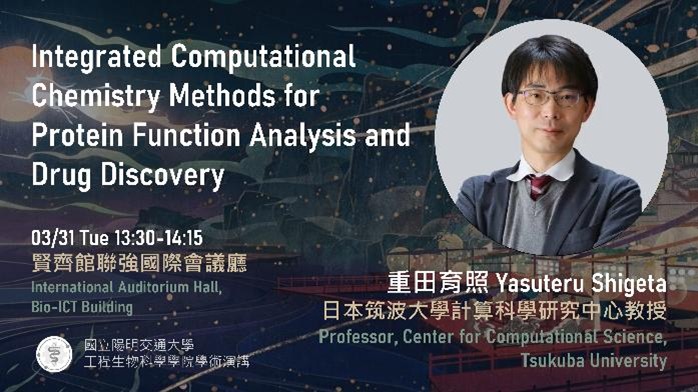
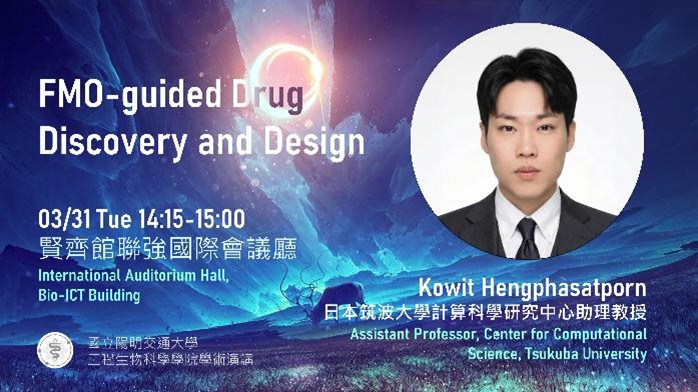
[專題演講] 20260331日本筑波大學計算科學研究中心Professor Yasuteru Shigeta 重田育照教授、Professor Kowit Hengphasatporn蒞臨演講

本院3/31(二)邀請到日本筑波大學計算科學研究中心Professor Yasuteru Shigeta 重田育照教授主講Integrated Computational Chemistry Methods for Protein Function Analysis and Drug Discovery (13:30-14:15)、Professor Kowit Hengphasatporn主講FMO-guided Drug Discovery and Design (14:15-15:00)

地點在1F聯強國際會議廳,歡迎踴躍參加!

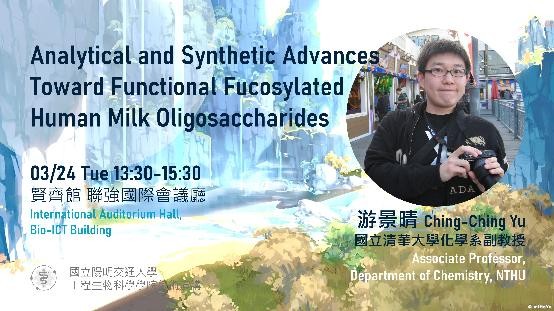
[專題演講] 20260324國立清華大學化學系游景晴副教授蒞臨主講Analytical and Synthetic Advances Toward Functional Fucosylated Human Milk Oligosaccharides分析與合成技術推進下的功能性岩藻糖化母乳寡糖

本院3/24(二)邀請到國立清華大學化學系游景晴副教授蒞臨主講Analytical and Synthetic Advances Toward Functional Fucosylated Human Milk Oligosaccharides分析與合成技術推進下的功能性岩藻糖化母乳寡糖 (13:30-15:00)

地點在1F聯強國際會議廳,歡迎本校教職員生踴躍參加!

115學年度陽明交通大學工程生物科學學院碩士班考試入學第一次備取通知(115.03.18更新)

115學年度碩士班考試入學備取生名單及報到注意事項

即日起至115年3月25日(三)下午3點前 (不含六、日、國定假日)完成報到手續

一、報到地點:新竹市博愛街75號賢齊館325室。

二、報到登記時需攜帶以下資料:身分證、畢業證書正本(應屆畢業生請填寫切結書)。

※未報到者視同放棄,缺額將由備取生依序遞補登記報到。

如欲放棄請填寫回覆放棄聲明書告知。

831生物科技學系甲組

8300047 備1   

8300019 備2

8300040 備3(已預先放棄)

8300016 備4

8300012 備5

8300031 備6

832分子醫學與生物工程研究所甲組

8300004 備1

8300034 備2

833生物資訊及系統生物研究所甲組

8300045 備1

842分子醫學與生物工程研究所乙組

8400012 備1

8400019 備2

可收碩士新生額滿實驗室 張晉源老師  李宗夷老師  李孟學老師

鴻海科技獎 25萬元等著碩博士生!

 申請說明 

  • 申請期間:2026年3月16日(一)至4月24日(五)止
  • 申請資格:具中華民國國民身分之在學碩士、博士生與今年(民國115年)之碩博班應屆畢業生。
  • 投件主題:

(1)【學術組】研究聚焦於:人工智慧、半導體、新世代通訊、低軌衛星、資安、量子計算、量子硬體等領域之創新技術。

(2)【應用組】研究聚焦於:機器人、數位健康、智慧電動車硬體與軟體、智慧製造、智慧城市、AI 基礎建設等領域之創新技術。

  • 投件要件:需提交於民國114年1月1日至民國115年4月24日間,被接受之(印出或有接受函)於相關學術期刊、會議論文發表的學術論文(含證明)。申請者須為除指導教授以外的第一作者或通訊作者。
  • 申請報名及更多詳情,請參閱「鴻海科技獎」官網:https://www.foxconnfoundation.org/plan/technology_award

隨信檢附本屆獎項之公告辦法、申請書及海報電子檔供貴單位參考,如連結

懇請貴系惠允協助公告於系所網站、佈告欄,與透過師生郵件轉發。

如有任何問題,請不吝與我們聯繫賜教。
我們誠摯感謝您的支持,並期待與貴系所攜手培育更多科技人才!

敬祝  萬事順心

鴻海科技獎活動小組 敬上

| 官方網站 | https://www.foxconnfoundation.org/plan/technology_award
| 客服信箱 | techawards@foxconnfoundation.org
| 官方LINE | @098sucjr

工生院23週年院慶謹訂於115年4月18日(六)於博愛校區賢齊館舉辦

本院謹訂於115年4月18日(六)於博愛校區賢齊館舉辦工程生物科學學院(前交大生科院)23週年院慶,結合學術成果發表、院友回娘家、第四屆傑出院友頒獎典禮及生涯分享、杜元坤工程生物獎學金頒獎典禮的工生院23週年年度盛事,誠摯邀請所有老師及在校同學共同參加。

參加活動報名截止日期:115年 3月 27日(院慶報名<請點我)

點選活動網址,查看活動詳情

image.png
zh_TW